
Finding People Through Salt Lake City Records
Choose the first record by the fact already known. A full name works well in Utah Courts Xchange, the Assessor owner field, and the county deed index. An old street address points first to the Assessor, parcel map, permits, and historical directories. For a deceased relative, begin with vital indexes, cemetery records, newspapers, and probate. Each source answers a narrow question, so a strong match comes from two or more independent records.
Salt Lake City is both Utah's capital and the Salt Lake County seat. That puts municipal, county, and state files close together, but it does not merge their duties. The City Recorder keeps municipal acts and handles city GRAMA requests. The County Recorder keeps land-title documents. Utah courts hold case files, and state or county vital-record offices handle certificates.
- Standardize the person's name, including a middle initial, former surname, or likely spelling variant.
- Search current property and court records, then note parcel numbers, case numbers, dates, and party roles.
- Use the stable number from one result to reach the full record or related office file.
- Compare addresses and dates with directories, marriage records, probate, cemetery entries, or newspapers.
- Ask the right custodian for material that has not been posted online.
Note: A name match alone is not identity proof; compare dates, addresses, middle names, and record roles before drawing a conclusion.
Salt Lake City People Search Offices
The local records system has two offices called “Recorder,” and they serve different purposes. Salt Lake City Recorder staff preserve council proceedings, ordinances, resolutions, municipal election material, and city request files. Salt Lake County Recorder staff preserve deeds, liens, plats, judgments, patents, and other instruments that affect land title. The County Clerk Marriage Division supplies copies of county-issued marriage licenses.
The three offices below are useful starting points. The Salt Lake City public records access overview supplies the deeper rules for classifications, copies, and formal requests.
Salt Lake County Recorder
Land-title instruments
Salt Lake County, Utah
Data Services: 385-468-8145
Salt Lake County Clerk
2001 South State, Suite S2-200
Salt Lake City, UT 84114
385-468-7300
Salt Lake City Recorder
451 South State Street, Suite 415
Salt Lake City, UT 84111
801-535-7671
Search Salt Lake City Property Deeds
The Salt Lake County Recorder's permanent grantor and grantee index is the name trail for recorded land documents. A grantor transfers an interest; a grantee receives one. Deeds are central, but the index also covers final judgments, claims, patents, and decrees that affect title or possession. The official material does not state the oldest online year, so absence from the web database should not be treated as absence from county files.
The Recorder Public Search gateway shows where online property and document research begins.
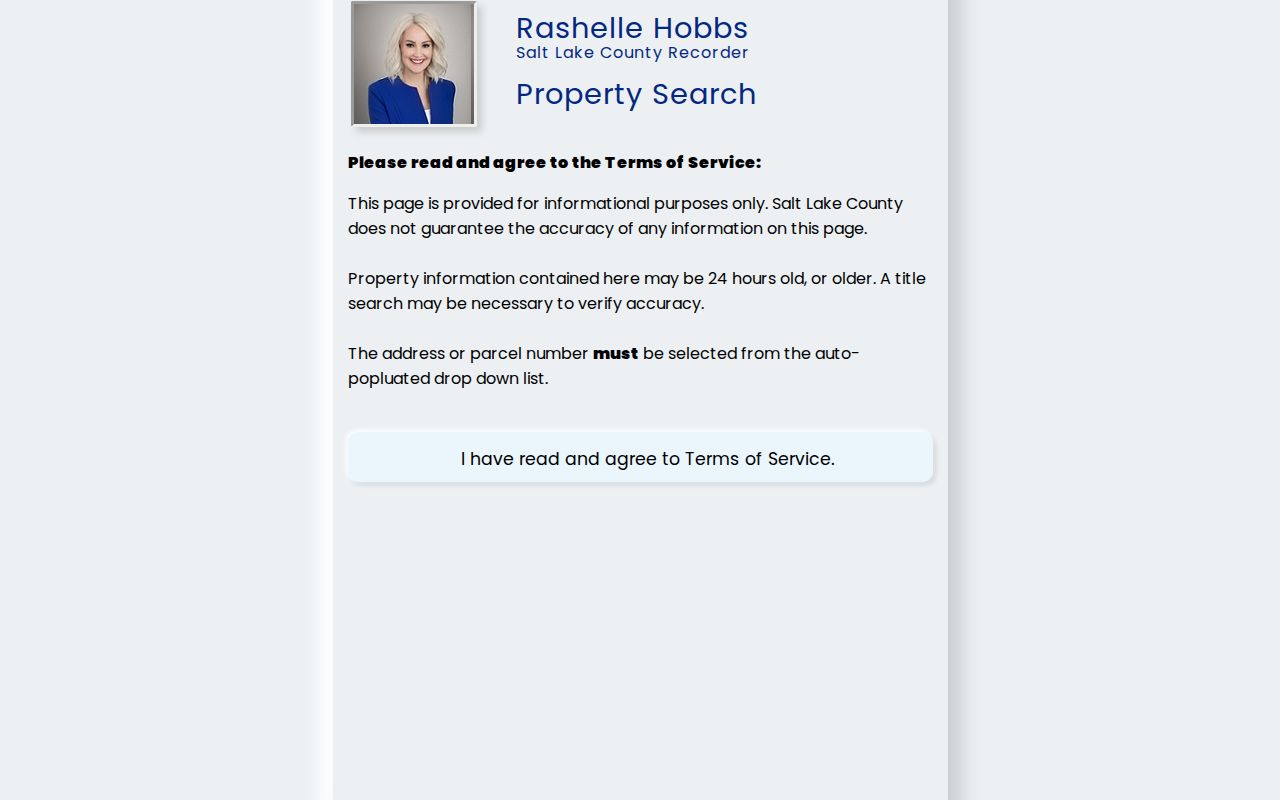
The gateway leads to the Salt Lake County Recorder paid Data Services portal. A 24-hour pass costs $5, while account and office routes remain available. Password help is at 385-468-8145 and technical help is at 385-468-8159. County Archives is the fallback for old appraisal cards, tax ledgers, land certificates, permits, and building photographs.
- Grantor
- The person or entity giving or transferring a recorded interest.
- Grantee
- The person or entity receiving that interest.
- Index
- A finding list that points to a document; it is not always the document image.
- Legal description
- The plat, lot, block, or boundary text that identifies land more reliably than a street label.
Trace Salt Lake City Property Records
Property research works as a chain: Assessor search, parcel map, then Recorder instruments. The current assessment roll can connect an owner name or address to a 14-digit parcel number. That number is the best bridge between systems when units, street directions, or spellings differ. A listed owner is not proof that the same person lives at the property, so compare the parcel result with a dated directory or another current record.
The Salt Lake County Assessor Find a Parcel tool exposes three routes into the roll.
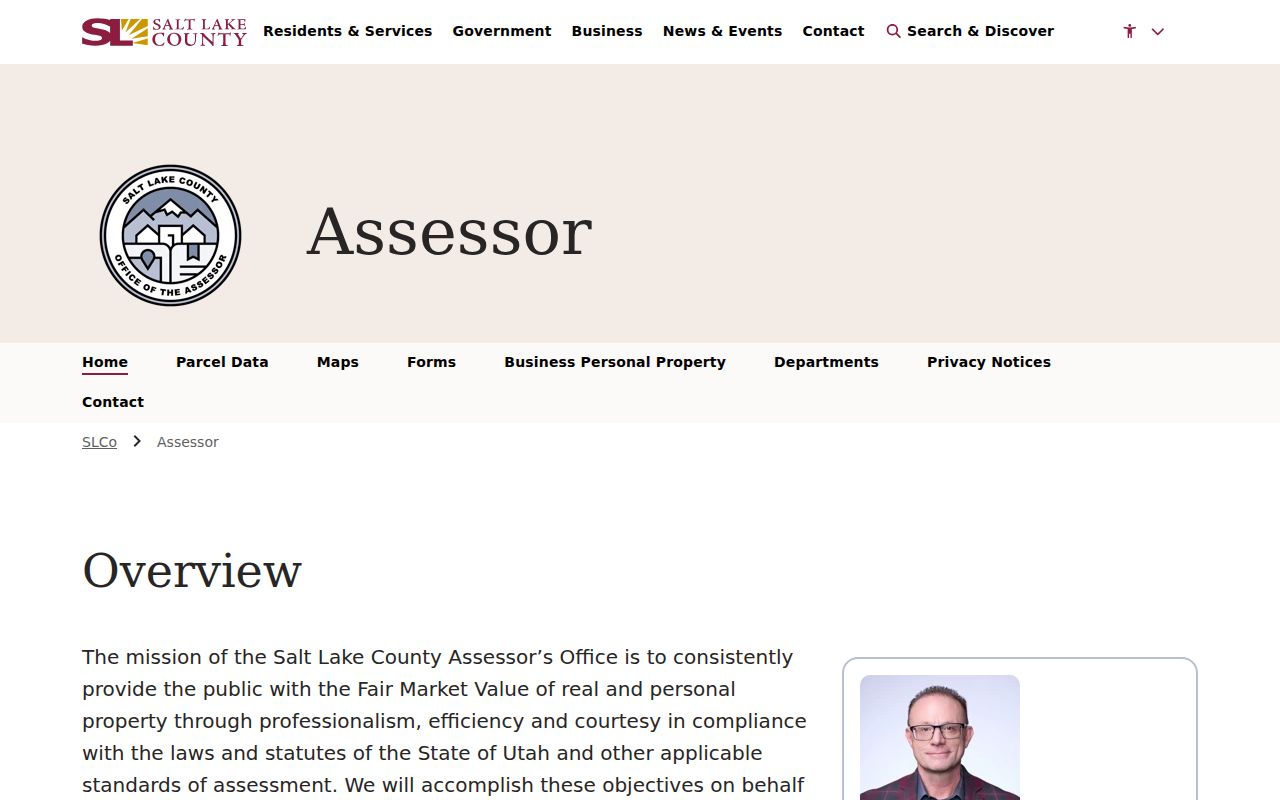
The screen supports a person-to-parcel search as well as an address-to-owner search. After finding the parcel, the GIS viewer can confirm geometry, property type, tax district, map layers, and nearby parcels.
| Assessor field | Input | Format guidance |
|---|---|---|
| Owner | Person name | Last Name, First Name |
| Address | Street address | Choose from autocomplete suggestions |
| Parcel Number | County parcel ID | 00-00-000-000-0000 |
Salt Lake City Search Geography
A Salt Lake postal address does not always prove that a place lies inside Salt Lake City limits. Historical publishers also treated the valley as a wider market. The 1915 Polk directory included Murray, Sandy, Midvale, Garfield, and suburbs, while later volumes could include South Salt Lake. City permits and licenses stop at the corporate boundary, even when a directory or ZIP label reaches beyond it.
The numbered grid adds another search problem. The same road may appear as “Sixth South,” “6th South,” or “600 South.” Main Street is the east and west reference, while South Temple is the north and south baseline. Try written-number and hundred-block forms in old directories, newspapers, permit files, and scans. For parcel work, the legal description and parcel ID are more stable than a reformatted address.
Note: Confirm city jurisdiction before sending a request, since county and nearby municipal offices may hold records for a Salt Lake mailing address.
Search Salt Lake City Court Records
Utah Courts Xchange searches district and justice cases by party name. Third District Court handles felony, class A misdemeanor, and broad civil matters. Salt Lake City Justice Court handles most class B and C misdemeanors, infractions, traffic matters, and small claims. Results can reveal a case number, filing date, court, case type, parties and roles, judge, charges, plea, disposition, and a dated case history.
The Utah Courts Xchange search offers paid guest or subscription access.
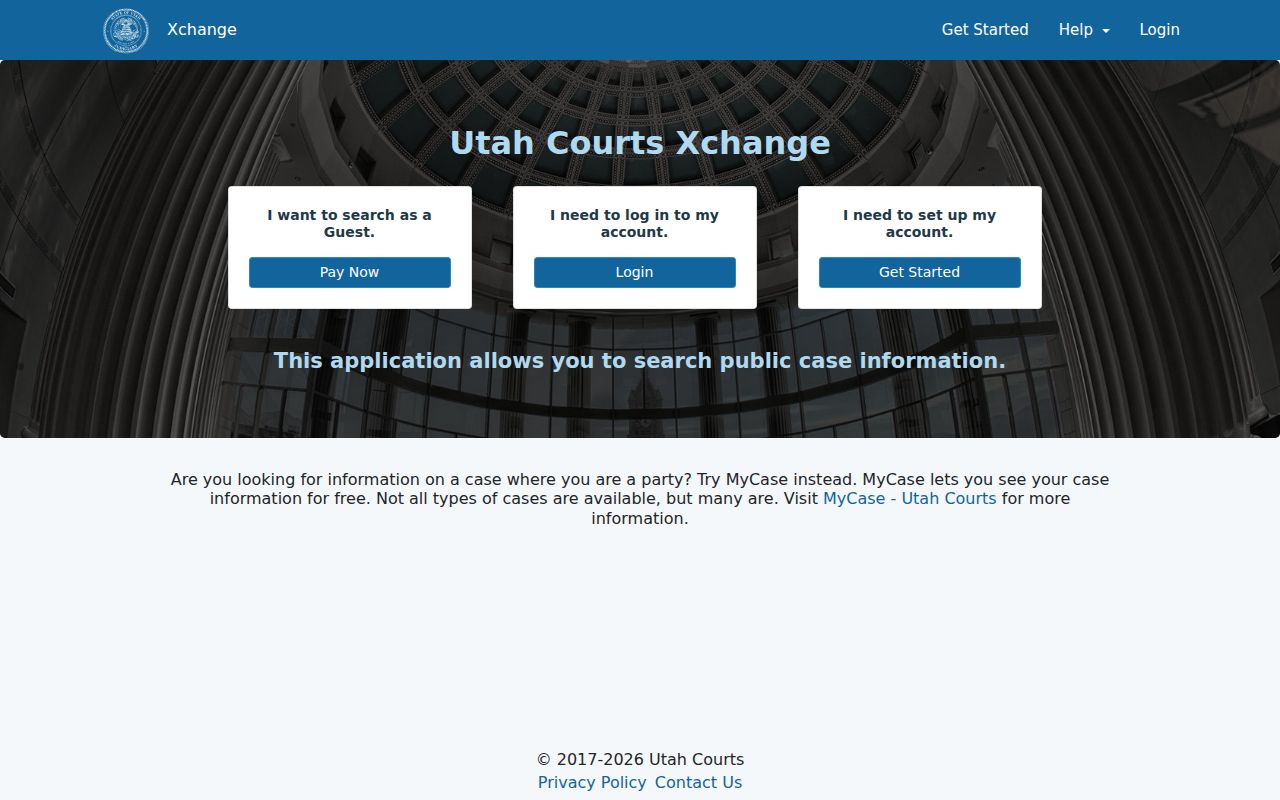
Each online search is billable, and results stop at 500 matches. Free public Xchange access is available at most district courthouses and at the Utah State Law Library. Sealed and expunged cases, juvenile matters, child-welfare cases, and sealed adoption or civil-commitment files do not appear.
| Court path | Typical Salt Lake City matters | Access |
|---|---|---|
| Third District Court | Felony, class A misdemeanor, civil, and probate | Xchange or courthouse terminal |
| Salt Lake City Justice Court | Traffic, infractions, small claims, class B and C misdemeanor | Xchange; call before relying on terminal access |
| Utah State Archives | Older district, probate, civil, and naturalization material | Digital index, research request, or reference room |
Salt Lake City Vital Records Lookup
Utah DHHS Office of Vital Records and Statistics issues recent birth, death, marriage, and divorce certificates. Salt Lake County Health Department also provides a local vital-records office at 610 South 200 East, with service by phone at 385-468-4230. Restricted certificates go to the person named, immediate family, a legal guardian, or a designated legal representative who supplies valid ID and proof of relationship or authority.
The Utah vital certificate ordering system supports online requests; in-person requests go through most local health departments, and mail requests require the application, fee, and ID.
Birth records become public after 100 years, deaths after 50 years, and marriages and divorces after 75 years under Utah Code § 26B-8-125. Historical research then moves to Utah State Archives and county archival collections. Salt Lake City began government birth registration in 1890, before Utah required statewide registration in 1898.
Salt Lake City Marriage and Probate Records
A marriage license, a state marriage certificate, and a divorce decree are different records. Salt Lake County Clerk keeps the original county license and can supply a $2 uncertified or $5 certified copy. Utah's state marriage and divorce product is a short-form certificate or abstract. A divorce decree comes from the district court, or from Archives when custody has transferred.
Probate can connect a decedent, heirs, guardians, property, and a name change. In territorial Utah, county probate courts had broad authority and also heard some civil and criminal matters. That means a person may appear in “probate” minutes for a dispute unrelated to an estate. Salt Lake County Third District resources include a probate index for 1876 through 1979 and a civil-actions index for 1851 through 1969.
Researchers must allow for gaps. Third District territorial minutes before 1858 are missing, records from September 1871 through March 1873 have a gap, and changing district boundaries mean some entries omit the county of origin.
Reconnect Through Salt Lake City Archives
Historical directories, school yearbooks, and newspapers can rebuild a person's address trail or help reconnect classmates and relatives. The first located Salt Lake directory is G. Owens's 1867 volume. Later R. L. Polk books used alphabetical and geographic arrangements, letting a researcher move from surname to address, then from address to neighbors or later occupants.
Salt Lake City Library's Periodicals Archives has Deseret News Weekly microfilm beginning June 15, 1850, as well as local clippings and magazines. Special Collections holds photographs, maps, slides, local-history books, Masonic Library Records, scrapbooks, and pamphlets. Much of it is for in-library use, with scanners and microfilm readers on hand. County Archives adds records from 1852 forward and currently requires advance contact rather than a walk-in visit.
The University of Utah's Utonian yearbooks document campus communities. The Marriott Library's Salt Lake Tribune negative archive contains more than 171,000 photographs from the 1930s through the 1960s, giving visual context for people, firms, streets, and civic events that a name index cannot supply.
Salt Lake City Jail Record Search
No single custody lookup covers every person connected with Salt Lake City. The county jail system covers its prisoner population, while Utah Department of Corrections applies to its own current custody and supervision population. A federal locator is separate. Start at the local level when the question concerns a recent booking or a person who may be awaiting trial or sentence.
The Salt Lake County Sheriff Find a Prisoner hub is the local starting point.
This county screen should be checked before assuming that a missing Utah Corrections result means no current local custody.
Salt Lake City Corrections Record Lookup
Utah Department of Corrections covers people currently incarcerated in a state facility or under probation or parole supervision. It expressly excludes people awaiting trial or not yet sentenced in county jails. That boundary explains why a complete Salt Lake City custody check may require both the county and state tools.
The Utah Corrections Offender Search accepts either a name or an offender number.
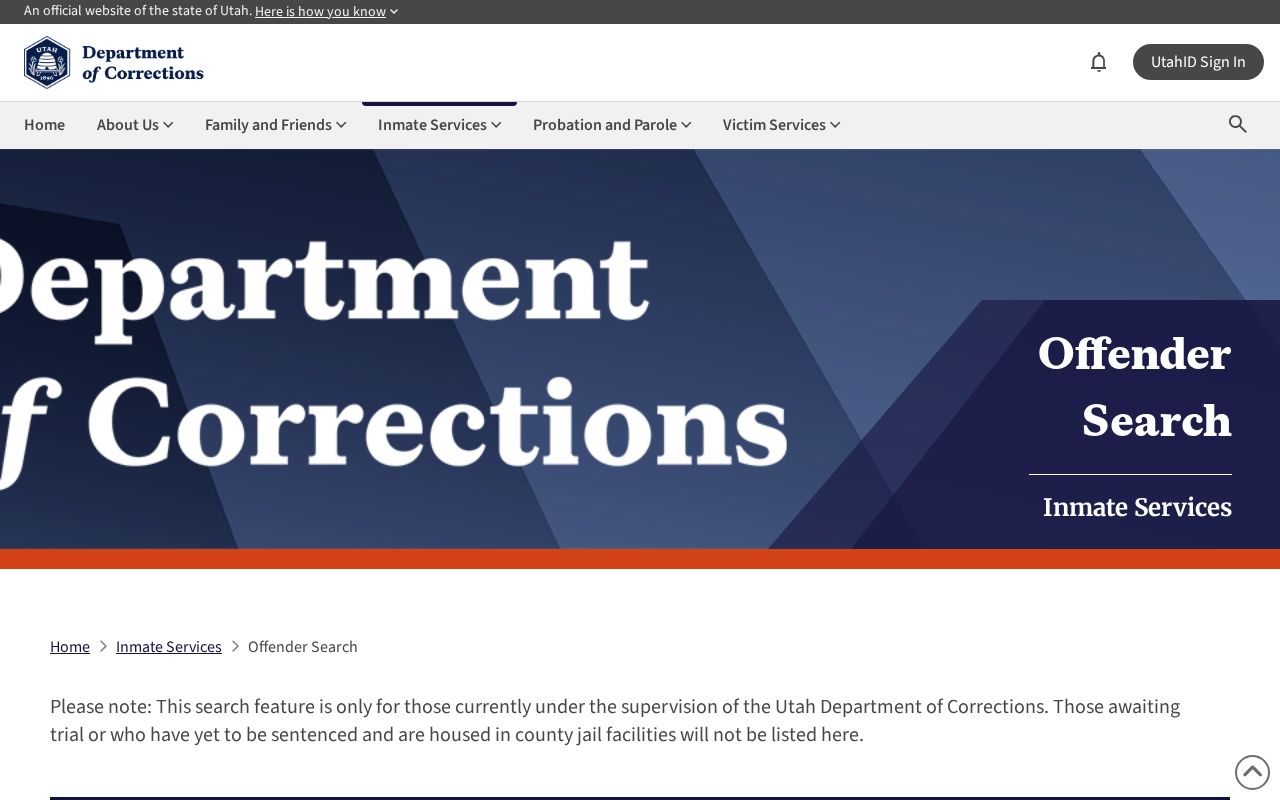
For a name search, first and last name each require at least one letter, while middle name is optional. Results apply only to the current UDC population.
Salt Lake City Registry Record Search
Utah's official Sex and Kidnap Offender Registry serves a separate public-safety purpose from a case docket or custody roster. A registry entry should be interpreted under that system's own scope and current instructions. It cannot establish every court event, jail booking, or correctional status connected with a person.
The official Utah Sex and Kidnap Offender Registry provides the state's registry search.
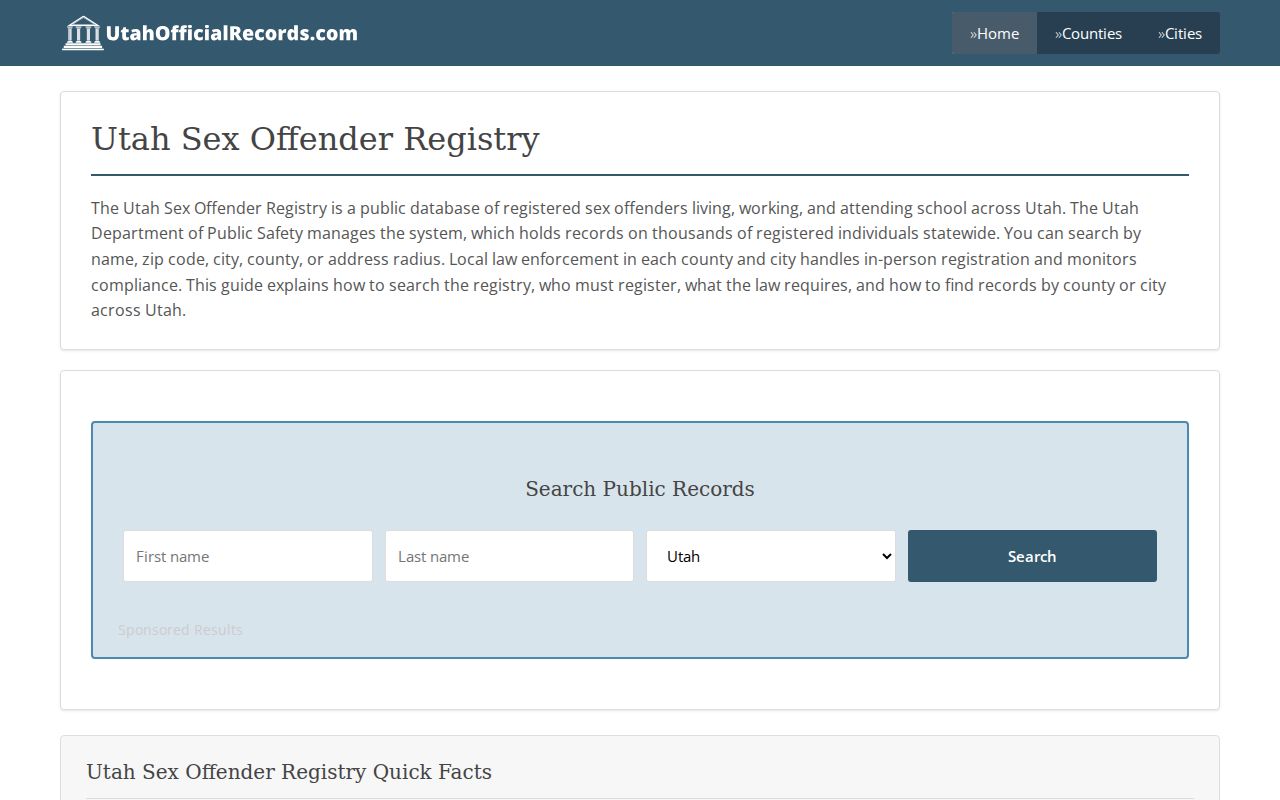
Registry information must be read within its stated scope. It is not a substitute for court case records, jail data, or current Corrections status.
Salt Lake City Voter Record Limits
Utah Voter Status Search is designed for a voter to check a registration and related voting information. Its visible labels include First Name, Last Name, Date of Birth, County, Street Address, and Voter ID, but the official interface does not publish which combinations are required or how partial matches behave. Salt Lake County Elections provides the local counter and phone fallback.
A purchased voter file is a different product. Public fields can include legal name, age range, residence and mailing addresses, districts, affiliation, status, update date, and election participation history. It never reveals candidate or issue choices. Full birth date, government ID numbers, Social Security number, email, and phone remain private. At-risk registrations receive added protection, and Utah Safe at Home supplies a substitute-address and mail-forwarding program for eligible survivors.
Detailed fields, privacy rules, and request options are organized in the Salt Lake City voter records lookup.
Request Salt Lake City Records
Records missing from a portal may still be available through a counter, written request, archive appointment, courthouse terminal, or library collection. Salt Lake City's JustFOIA system routes municipal requests under the Government Records Access and Management Act, known as GRAMA. A focused request should name the department, record type, people, address, event date, and known case or permit number.
The city GRAMA request portal is the universal written path for municipal material.
GRAMA ordinarily allows up to ten business days for a response. Current city fees include staff time at $25 per hour, billed in quarter-hour increments after the first 15 minutes. Building permits add another route: Citizen Access covers roughly 2008 forward, Laserfiche holds older material, and GRAMA is the fallback for some pre-2007 files. The permit search works better with reduced address text such as “451 State” than with every directional word.
Use records only for lawful personal research. Never use an address, court entry, voter detail, or directory record to stalk, harass, threaten, or harm someone.
Official Salt Lake City Search Sources
Official systems are strongest when a claim needs a named custodian, file date, case number, parcel ID, or certified copy. Commercial people-finder databases may be faster for a broad name query, but their records can be stale, merged, or detached from the source. Treat them as leads, never as proof. Return to the office index or original file before relying on a match.
| Search route | Best use | Main limit |
|---|---|---|
| Official portal | Current index details and stable record numbers | May charge or omit older material |
| Office or courthouse terminal | Free court access or records not exposed on the web | Hours, travel, or a request may apply |
| Library or archives | Past addresses, family links, images, and pre-digital records | Some items require an appointment or in-room use |
| Commercial database category | Broad discovery from a thin starting fact | Not a certified or authoritative source |
Utah's Consumer Privacy Act gives qualifying consumers rights involving covered private data controllers, including access, correction, deletion of supplied data, portability, and opt-out rights. It does not erase government records that must be kept under Utah law.
Utah Archives Expand Salt Lake Searches
Archive catalogs keep changing even when the underlying Salt Lake City records are old. In June 2026, the Utah Archives Digital Initiatives Team received a CIMA Innovator Award for expanding online access, building systems for born-digital preservation, and modernizing public digital services. New and revised finding aids followed in May and June updates, including Salt Lake City material available through the Reference Room rather than as a scanned image.
The Utah State Archives research catalog combines digital collections, name indexes, guides, and archivist help. Its more than 1.7 million free digital items include court, land, and vital-record routes, but the catalog is only one access channel. A finding aid can identify a useful box, reel, or series even when the record itself is not online.
That distinction matters in Salt Lake City. Territorial court jurisdiction shifted, old addresses changed form, and local directories reached beyond city limits. A careful search keeps the office, date, geography, and record series attached to every name.