
Salt Lake City Public Records Inventory
Salt Lake City public records do not sit in one government database. The record type controls both the custodian and the access rule. City administrative files generally pass through the City Recorder and the Government Records Access and Management Act, known as GRAMA. County land, assessment, marriage, and jail files remain with separate Salt Lake County offices. Utah agencies run the court, corrections, vital-record, business, and professional-license systems.
| Record set | Official keeper | Online route | Access path |
|---|---|---|---|
| City actions, permits, police reports | Salt Lake City Recorder or the responsible department | City GRAMA portal; Citizen Access for newer permits | Online request, department counter, or written GRAMA request |
| Deeds, liens, plats, title instruments | Salt Lake County Recorder | Paid Data Services portal | $5 for 24-hour portal access or Recorder office help |
| Owners and parcels | Salt Lake County Assessor | Find a Parcel and Parcel Viewer | Free web search or Assessor counter |
| District and justice cases | Utah courts | Xchange | Paid web use; free terminals at most district courthouses and the State Law Library |
| Birth, death, marriage, divorce certificates | Utah Vital Records, local health office, County Clerk, or court | State certificate ordering | Eligibility-based online, mail, or in-person order; Archives after public transition |
| Current custody and supervision | County Sheriff, Utah Corrections, or federal prisons | Three distinct official lookups | Free search by the system holding the person |
For Salt Lake City records, public does not mean every field is visible. Xchange omits sealed and expunged matters, juvenile cases, and several protected family-case categories. Recent vital certificates are limited to qualified requesters. Salt Lake City public records may also be classed as private, controlled, or protected under GRAMA. The public voter file excludes sensitive identifiers and protected at-risk information; its narrower rules are covered with the Salt Lake City voter record process.
Salt Lake City Records Custodians
In Salt Lake City, the word “recorder” causes a common mix-up. The Salt Lake City Recorder preserves council and redevelopment proceedings, ordinances, resolutions, municipal election material, and city GRAMA requests. The Salt Lake County Recorder records private land-title instruments. The County Clerk keeps county marriage licenses, while the Assessor turns recorded property information into an owner and parcel search.
Salt Lake City Recorder
451 South State Street, Suite 415
Salt Lake City, UT 84111
801-535-7671
Salt Lake County Recorder
Land-title instruments and permanent grantor/grantee indexes
385-468-8145
Salt Lake County Clerk
2001 South State, Suite S2-200
Salt Lake City, UT 84114
385-468-7300
Counter and offline routes matter for Salt Lake City research. The City Recorder lists weekday service from 9 a.m. to 5 p.m. The Assessor and County Clerk list weekday hours from 8 a.m. to 5 p.m. County Archives does not accept walk-ins and asks researchers to allow 15 business days for a reply. Its 1852-present holdings include appraisal cards, tax ledgers, permits, building photographs, historic vital records, and land certificates.
Salt Lake City Deed Records
Salt Lake City land research uses the County Recorder's permanent grantor and grantee indexes for deeds, final judgments, claims, patents, and decrees that affect title or possession. A grantor transfers an interest; a grantee receives it. Online Data Services is account-gated and advertises $5 for 24-hour access. The official pre-login material does not state the first indexed year, exact search fields, image charge, or result fields, so those details should not be assumed.
The paid portal is not the only route. Recorder staff and Data Services provide office access, password help at 385-468-8145, and technical help at 385-468-8159. Older property evidence also appears at County Archives in appraisal cards, tax books, land certificates, photographs, and permits. Recording fees are charges for placing a new instrument in the official record, not proof of what an existing copy will cost.
- Index
- A finding list that points to a filed instrument; it is not always the instrument image.
- Certified copy
- A copy carrying the custodian's formal certification that it matches the official record.
- Custodian
- The agency or office responsible for keeping and responding for a record.
- Exemption
- A legal reason that permits or requires an agency to withhold all or part of a record.
Note: The Recorder's published $40 instrument charge is a recording fee, not a verified price for retrieving a deed copy.
Salt Lake City Property Records
The Assessor and GIS systems form a free Salt Lake City public-record bridge to the Recorder. Start with a name, street address, or parcel number. The parcel ID remains useful when street spelling or unit formats change. The map viewer then adds parcel geometry, property type, tax district, map layers, imagery, printable PDF maps, and shape-based export. Its data originates with the Recorder's descriptions and plats.
| Find a Parcel field | Input type | Required | Format note |
|---|---|---|---|
| Owner | Text | No | Enter Last Name, First Name |
| Address | Autocomplete text | No | Suggestions appear while typing |
| Parcel Number | Text | No | Use 00-00-000-000-0000 |
| Search / Reset | Buttons | Not applicable | Run or clear the form |
A situs address is the physical parcel location. A tax mailing address is where notices go and may belong to a nonoccupant owner. A legal description identifies land by plat, lot, block, or boundaries and can survive street renumbering. The Assessor counter supplies another channel when autocomplete fails. Historical appraisal and tax evidence routes to County Archives.
Search Salt Lake City Court Records
Utah Courts Xchange covers Salt Lake City district and justice cases within its statewide system. It can search all cases or judgments, a county or named court, and party names with optional case, citation, birth-date, case-type, and date controls. Search results show the county, court, case type and number, filing date, party names and roles, plus links to available histories or documents. No result list exceeds 500 entries.
| Xchange control | What it changes | Useful limit |
|---|---|---|
| Jurisdiction | District Court, Justice Court, or both | Separates higher-level matters from local traffic, infraction, and small-claims files |
| Last name / Company and First Name | Finds a principal party | An asterisk in first name returns variants and middle-initial forms |
| Search Scope | Statewide, county, or specific court | Helps control common-name results |
| Date Range Panel | Filters filing, disposition, or judgment dates | Each search click is billable online |
Guest use begins with $10 credit, then costs $0.35 per search and $1 per document. A subscription has separate setup and monthly charges. Free Xchange terminals are available at most district courthouses and at the Utah State Law Library; some justice courts offer access after a call. Public district-court documents filed since July 2010 may be bought when imaged. Older court, probate, and naturalization files route to Utah Archives.
Salt Lake City Vital Records Access
Recent Salt Lake City birth, death, marriage, and divorce certificates are not open name directories. Utah Vital Records limits them to the person named, immediate family, a guardian, or a designated legal representative. Birth records become public after 100 years, death records after 50, and marriage and divorce records after 75 under Utah Code § 26B-8-125. Public historical records then move into archive channels.
The Utah certificate ordering service supports online requests for birth, death, marriage, and divorce records, but not stillbirth records. Most local health departments accept in-person applications with valid identification and the fee. Mail requests require the form, payment, and ID, and the official guidance says to allow at least six weeks. Salt Lake County's local vital-record office is at 610 South 200 East and can be reached at 385-468-4230.
The official Utah Vital Records application choices show why the record type matters.
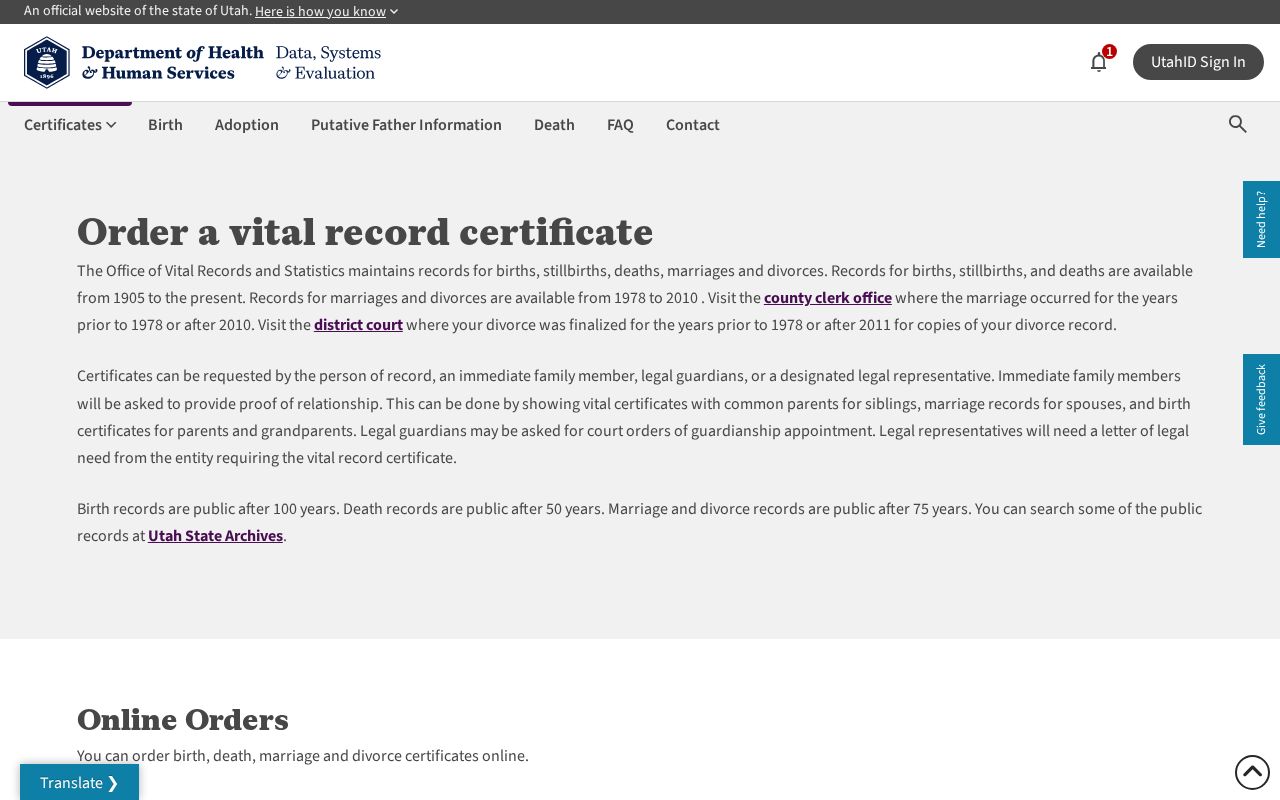
The screen separates certificate products, but eligibility and identification still govern access to a recent record. A County Clerk certified marriage license is different from the state's short-form marriage certificate, and a divorce decree must come from the court. County marriage-license copies may be requested by mail with the names used on the application, event date and place, and license number if known. Phone orders are limited to a named spouse.
Salt Lake City Custody Records
Salt Lake City custody records split by authority. The Salt Lake County Sheriff's Find a Prisoner hub covers pretrial detainees and locally held prisoners. Utah Department of Corrections searches only people currently incarcerated by the state or supervised on probation or parole. Its name mode requires a first and last name, while the other mode takes a UDC offender number.
A blank Corrections result does not rule out county-jail custody. The Federal Bureau of Prisons locator covers federal inmates from 1982 forward, and Utah's official Sex and Kidnap Offender Registry has name, city, county, ZIP, address, and radius routes. VINE adds free anonymous custody-change notifications. Each system answers a different question, and none substitutes for the others.
Note: The Sheriff's jail dashboard refreshes daily, but it reports population trends while limiting identifying details.
Salt Lake City Record Boundaries
Government level matters as much as the name on a file. A Salt Lake postal address can fall outside the city's corporate limits. County property offices still cover it, but Salt Lake City permits and licenses may not. The numbered street grid also produces variants such as “Sixth South,” “6th South,” and “600 South.” Searching each form can prevent a false dead end in an older index.
Permit access shows this split in practice. Citizen Access covers roughly 2008 to the present, while Laserfiche is the older channel. City guidance separately says some records before 2007 are unavailable online and should go through GRAMA, so the transition is not a perfect cutoff. It also recommends reducing a full address to a short form such as “451 State,” then opening the red Record Number and its attachments.
A permit trail can move from online search to Laserfiche, the City Recorder, or County Archives. City and county records therefore overlap around an address without becoming the same record. The Salt Lake City permits hub routes current services, while historic building photographs, appraisal cards, and tax ledgers remain archive sources.
Salt Lake City Territorial Records
Early Utah “probate” files are broader than the label suggests. Territorial county probate courts handled wills, estates, guardianships, adoptions, and name changes. For part of the territorial era, they also heard civil and criminal matters. A person may therefore appear in probate minutes even when no estate was involved. Probate shifted to district court when statehood ended county probate jurisdiction in 1896.
The Third District territorial minutes cover 1858 through 1896, but they have gaps. Pre-1858 minutes are missing, September 1871 through March 1873 is absent, court boundaries changed, and entries often omit county of origin. The digitized Salt Lake County Third District probate index spans 1876 through 1979. Public estate and guardianship files differ from sealed adoption material, and Archives generally assists with district records more than 50 years old while courts keep newer cases.
This history changes the fallback plan. Search both probate and district series, treat territorial results as regional rather than purely county based, and use an Archives inventory before requesting a box or reel. Utah Archives continues to update finding aids even when the underlying records are not digitized.
Salt Lake City Records Fees
There is no single Salt Lake City public-record price. City staff time costs $25 per hour in quarter-hour increments after the first 15 minutes under the fee schedule amended in June 2026. Plain paper or plain-paper microfilm costs $0.10 per page, silver-paper microfilm costs $2, and a photo costs $5. A narrow request that staff can complete within 15 minutes avoids the staff-time charge.
Other offices price their own products. County marriage copies cost $2 uncertified or $5 certified, and a phone transaction adds $3. Xchange bills for searches and available document images. Recorder Data Services charges $5 for 24-hour access. Vital-certificate fees, court copies, and certification charges follow their own schedules. Ask whether an estimate covers research, a plain copy, an image, or certification before paying.
Keep the request focused. Name the record, date range, office, people, address, case number, or permit number you know. Precision can cut staff time and cost.
Request Salt Lake City Public Records
GRAMA, Utah Code Title 63G, Chapter 2, governs Salt Lake City and state public-record requests. The City Recorder accepts requests through the city's portal, and the Utah Open Records Portal can route requests to state and local records officers. A response is due as soon as reasonably possible and ordinarily within ten business days. Five business days applies when a requester establishes a public benefit rather than a personal one.
The Salt Lake City online GRAMA form provides the direct city submission channel for public records.
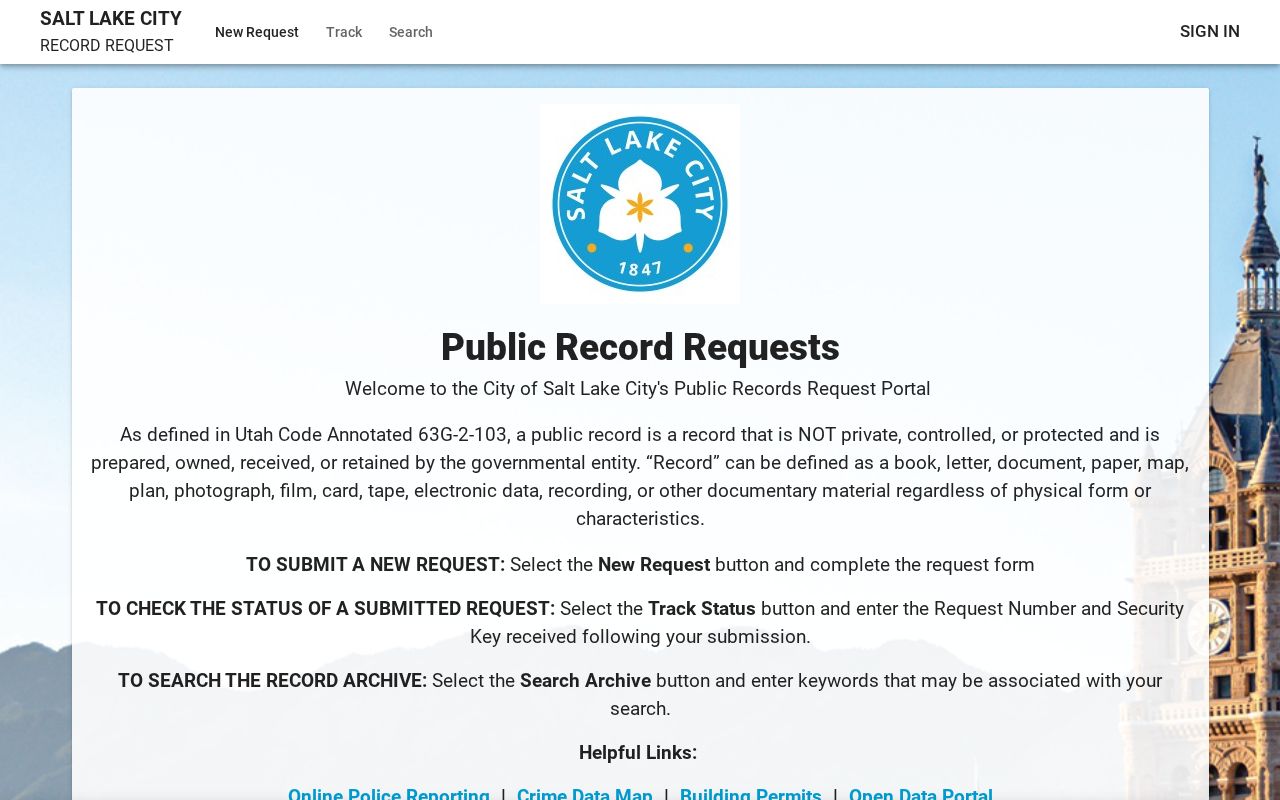
The portal creates a written trail for the request and its status. Police records also have a department-specific online route. The in-person service desk at 475 South 300 East is open weekdays from noon to 4 p.m.; it requires photo ID and payment by check or money order. A written request remains useful when the portal does not fit the record.
- Identify the government body that created or keeps the record. Do not send a deed request to the City Recorder or a city permit request to the County Recorder.
- Check the official index first. Record a parcel ID, case number, permit number, filing date, or other identifier that will narrow the request.
- Submit through the custodian's portal, office, or written channel. Give a clear date range, record description, names, addresses, and known identifiers.
- Ask for a cost estimate and state whether a plain electronic copy or a certified copy is needed. Respond promptly if the office seeks clarification.
- If access is denied, read the classification and appeal notice. Current review procedures should be checked against GRAMA Part 4 because Utah changed the review system in 2025.
Lawful personal use. Public access does not permit stalking, harassment, threats, or intimidation. Utah law can punish misuse even when the underlying fact came from an open government source.
Open Records Portal request-and-response files stay in the portal for five years, but records delivered to a requester remain there for only 60 days. Download authorized copies promptly. For an older or undigitized file, the practical chain is the custodian counter, a precise GRAMA request, County Archives by appointment, or Utah State Archives and the State Law Library, depending on who created the record.